
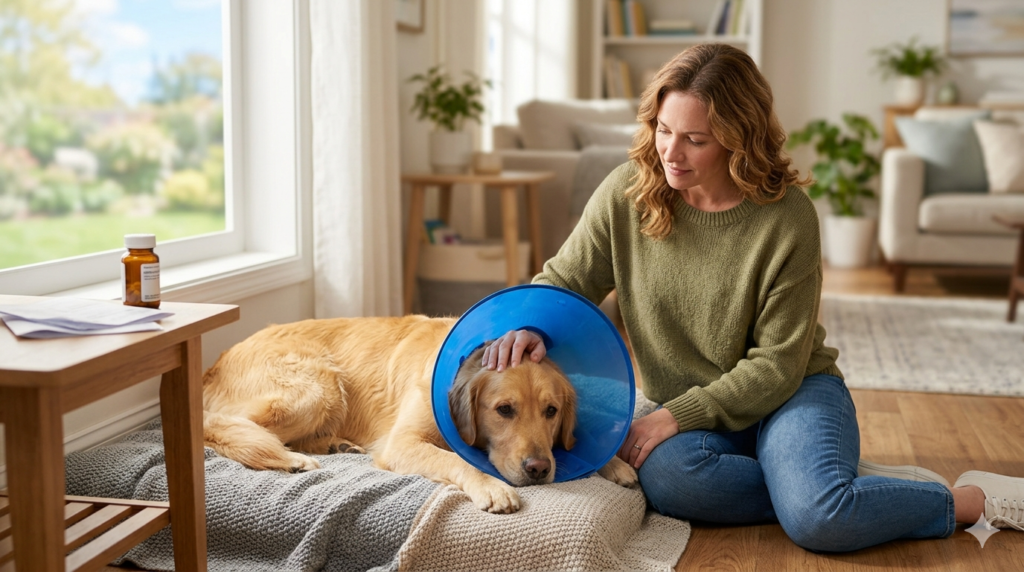
There’s a particular kind of silence that fills a house the night before a dog goes in for animal surgery. The food bowl gets picked up early. The water dish gets pulled at a certain hour. And the owner sits on the couch running through every possible scenario, wondering if they’re doing the right thing.
That silence is universal. It doesn’t matter whether your dog is scheduled for a straightforward spay or a complicated orthopedic repair — the worry feels the same. And the frustrating part is that most of that worry comes from not knowing what’s normal. What does recovery actually look like at home? How long before your dog acts like themselves again? What should you be watching for, and what can you safely ignore?
At Lacoste Animal Hospital in Brampton, these are the questions our team fields every single day. This guide covers the most common dog surgeries we perform, what recovery looks like for each, and the home care details that make the difference between a smooth healing process and a return trip to the clinic.
The Most Common Types of Animal Surgery in Dogs
Walk into any general practice veterinary hospital in southern Ontario, and the surgical caseload tends to follow a predictable pattern. Some procedures show up on the schedule weekly. Others appear seasonally or in clusters. But a handful of animal hospital surgery categories account for the overwhelming majority of what gets booked.
Spay and Neuter
Reproductive sterilization remains the single most frequently performed animal surgery in companion animal practice worldwide. A spay — technically an ovariohysterectomy — removes the ovaries and uterus through an abdominal incision. A neuter — orchiectomy — removes the testicles through a small incision in front of the scrotum.
These aren’t minor procedures, despite how routinely they’re performed. Both involve general anesthesia, surgical incisions, and a recovery period that demands careful home management. The AVMA’s guide to spaying and neutering outlines the established health and behavioural benefits, including reduced risk of certain cancers and the elimination of heat cycles and breeding-related roaming. But the AVMA also stresses that the optimal timing varies by breed, sex, and individual health status — there’s no universal answer for when to book the procedure.
Recovery from a routine spay typically runs ten to fourteen days. Males neutered without complications often bounce back faster, sometimes within seven to ten days. The key variable isn’t the procedure itself — it’s what happens at home afterward.
Soft Tissue Mass Removal
Lumps appear on dogs with surprising regularity, especially as they age. Some are benign lipomas — fatty deposits sitting just beneath the skin that grow slowly and cause no clinical harm. Others are mast cell tumours, fibrosarcomas, or histiocytomas that demand prompt surgical intervention.
The veterinarian’s decision to remove a mass depends on several factors: location, growth rate, fine needle aspirate cytology results, and whether the mass interferes with movement or organ function. When surgery is recommended, the goal is to remove the mass with clean margins — meaning enough surrounding tissue is taken to reduce the likelihood of regrowth.
Nala’s Story — A Lump That Didn’t Wait
Nala, a nine-year-old Labrador Retriever, had a small lump on her left flank that her owner first noticed during a bath. It felt soft, movable, and didn’t seem to bother Nala at all. Her owner assumed it was a harmless fatty lump and planned to mention it at the next annual exam.
Three months later, the lump had doubled in size. When the veterinarian performed a fine needle aspirate, the cytology came back suspicious for a mast cell tumour. Nala was booked for surgical excision the following week. Pre-surgical bloodwork through reference laboratory testing confirmed her organ function was normal, and the surgery went well — wide margins were achieved, and the histopathology report confirmed complete excision with no evidence of spread.
Nala’s story is a textbook example of why waiting on lumps carries risk. Had her owner brought her in when the mass was still small, the surgery would have been simpler, the incision smaller, and the recovery faster. A lump that doesn’t hurt your dog can still be dangerous.
Foreign Body Retrieval
Dogs eat things they shouldn’t. This is not a character flaw limited to puppies — adult dogs do it too, sometimes repeatedly. Socks, corn cobs, children’s toys, hair ties, rubber balls, and the occasional kitchen utensil all end up in the stomachs and intestinal tracts of dogs across Brampton with alarming regularity.
When an object can’t pass on its own, surgical retrieval becomes necessary. The veterinarian opens the stomach or intestine, removes the object, checks for tissue damage, and closes in layers. These procedures carry more risk than a typical soft tissue surgery because compromised intestinal tissue can leak, leading to peritonitis — a life-threatening abdominal infection.
Foreign body cases often arrive through emergency and urgent care rather than the elective surgery schedule. The dog presents with vomiting, lethargy, and abdominal pain. Imaging confirms the obstruction. The surgical team moves quickly.
Dental Extractions Under Anesthesia
Dental surgery in dogs tends to fly under the radar because owners associate it with “cleaning” rather than actual surgical intervention. In reality, extracting a fractured carnassial tooth with abscessed roots is a technically demanding procedure that involves sectioning the tooth, elevating each root individually, and closing the gum tissue with absorbable sutures.
Periodontal disease affects the majority of dogs over age three. When it progresses beyond the point where scaling and polishing can manage it, extraction becomes the standard of care. Left untreated, infected teeth seed bacteria into the bloodstream, with documented links to cardiac, hepatic, and renal complications.
Orthopedic Surgery
Cranial cruciate ligament tears represent one of the most common orthopedic injuries in dogs, particularly in medium to large breeds. The injury is functionally equivalent to an ACL tear in a human athlete, and the treatment is surgical stabilization — most commonly through a technique called TPLO (tibial plateau levelling osteotomy) or lateral suture stabilization.
Fracture repair, patellar luxation correction, and femoral head osteotomy (FHO) for severe hip dysplasia round out the orthopedic category. These are longer procedures with longer recovery timelines, often requiring eight to sixteen weeks of restricted activity before the dog can return to normal function.
What Recovery Actually Looks Like — A Realistic Timeline
Recovery timelines get oversimplified in most online resources. The reality is messier and more variable than a clean “7 to 14 days” estimate suggests.
The First 24 Hours
The first day home after vet surgery is about anesthesia recovery, not wound healing. Your dog may be groggy, unsteady on their feet, and uninterested in food. Some dogs whimper or vocalize as the sedation wears off — this doesn’t necessarily mean they’re in pain, though it can indicate discomfort. Offer water in small amounts. Feed half a normal portion of bland food if they show interest. Don’t force it.
The Canadian Veterinary Medical Association’s position on veterinary surgical procedures emphasizes that pain management is integral to surgical success and should include appropriate analgesics in the perioperative period. Most dogs go home with a multimodal pain protocol — typically an anti-inflammatory and sometimes an additional analgesic — that should be administered on schedule, not on an as-needed basis.
Days 2 Through 5 — The Deceptive Window
This is where most home care complications begin. By day two or three, many dogs start feeling significantly better. They want to play. They want to run. They try to jump on the couch or wrestle with another pet in the household. And this is precisely when incisions open, sutures tear, and surgical sites become contaminated.
Activity restriction during this period is not optional. Short leash walks for bathroom breaks only. No stairs if avoidable. No rough play. The e-collar stays on — no exceptions and no “just for a few minutes while I watch them” compromises.
Diesel’s Detour — When a Short Walk Went Sideways
Diesel, a two-year-old Boxer mix, was neutered on a Monday. By Thursday, he was acting like nothing had happened — charging around the house, trying to engage the family’s other dog in a wrestling match, and whining at the back door to be let out into the yard. His owner, seeing how energetic he was, decided a short off-leash romp in the backyard couldn’t hurt.
Twenty minutes later, Diesel had torn three sutures. The incision was gaping, the tissue underneath was inflamed, and there was debris in the wound from rolling in the grass. He came back to the clinic for wound lavage, re-suturing under sedation, a course of antibiotics, and an additional ten days of strict confinement.
Diesel’s situation was entirely preventable. The energy spike that occurs around days three to five is a normal response to feeling better — but feeling better and being healed are not the same thing. In Ontario, veterinary surgical procedures are governed under Ontario’s Veterinarians Act, which establishes standards of practice that include comprehensive post-operative care planning. Those discharge instructions exist because the surgical team knows exactly what complications look like when they’re ignored.
Days 7 Through 14 — The Monitoring Phase
By the end of the first week, soft tissue incisions should be showing clear progress. Swelling decreases. Redness fades. The edges of the incision should be sealed and dry. If sutures were placed externally, they’re typically removed between day ten and fourteen.
During this phase, your daily job is observation. Check the incision once a day. You’re looking for increasing redness rather than decreasing, any discharge that turns cloudy or develops an odour, swelling that grows instead of shrinking, and heat around the surgical site. One or two of these findings might be normal variation. Three or more together warrant a phone call.
Orthopedic Recovery — A Different Timeline Entirely
Dogs recovering from bone or ligament surgery operate on a fundamentally different schedule. Soft tissue heals in weeks. Bone remodelling takes months. A dog recovering from TPLO surgery, for example, is typically restricted from off-leash activity for a minimum of eight weeks, with gradual return to normal exercise over the following four to eight weeks after that. Radiographs at the eight-week mark confirm whether bone healing is progressing as expected.
The temptation to let a dog “test” the leg before it’s fully healed is one of the most common mistakes in orthopedic aftercare. Premature loading of a surgical repair can loosen implants, fracture healing bone, or cause the repair to fail entirely — resulting in a second surgery that’s more complex and carries higher risk than the first.
Home Care Tips That Actually Matter
Most post-surgical home care guides online are padded with obvious advice. Keep them comfortable. Give their medications. Watch the incision. These aren’t wrong — they’re just incomplete. Here are the details that tend to get missed.
Flooring Matters More Than You Think
Dogs recovering from abdominal or orthopedic surgery struggle on hardwood, tile, and laminate floors. Their coordination is compromised by pain medication, their core muscles may be sore from the incision, and their confidence is shaken. Throw rugs with non-slip backing in high-traffic areas, and consider yoga mats or rubber runners in hallways. This one adjustment prevents more post-surgical falls than any other intervention.
Separate Recovering Dogs from Other Household Pets
Even the gentlest housemate can accidentally bump, step on, or encourage play from a recovering dog. Keep them in a separate room or use baby gates to create a recovery zone. This reduces stress, prevents accidental wound contact, and gives the recovering dog a quiet space to sleep — which is the single most productive thing they can do during the first week.
Feed Smaller, More Frequent Meals
General anesthesia disrupts the gastrointestinal tract. Most dogs experience reduced appetite for twelve to forty-eight hours after surgery, and some develop mild nausea. Offering small meals three to four times per day rather than one or two large meals reduces the risk of vomiting and makes it easier to monitor whether appetite is returning normally.
Don’t Skip the Follow-Up Appointment
It’s tempting — especially if your dog looks fine and the incision seems healed. But the follow-up visit isn’t just about checking sutures. The veterinarian assesses internal healing, evaluates pain levels, reviews whether medications need adjustment, and clears the animal for return to normal activity. Skipping this step means making those calls yourself, and most owners don’t have the clinical training to make them accurately.
Knowing When Something Isn’t Right
Not every complication announces itself dramatically. Some of the most serious post-surgical problems develop slowly and subtly. Seroma formation — a pocket of fluid collecting beneath the incision — can look like normal swelling at first. A low-grade surgical site infection might present as nothing more than a dog that’s “just a bit off” in the eyes of the owner.
Call your veterinary team if you notice any of these within the first two weeks: your dog refuses food for more than twenty-four hours after the first day, the incision site develops new swelling after initially improving, there’s any discharge with colour or odour, your dog becomes increasingly lethargic rather than gradually more alert, or you see them straining to urinate or defecate. At Lacoste Animal Hospital’s pet surgery services team, these calls are expected and encouraged. Early intervention on a minor complication prevents it from becoming a major one.
How to Choose the Right Animal Surgery Team in Brampton
Families in Brampton and across the Peel Region searching for animal surgery near me deserve to know what separates a well-run surgical practice from a clinic that treats surgery as an afterthought.
Ask about their anesthetic protocols — are they individualized to each patient, or is there a standard cocktail applied across the board? Ask whether a dedicated veterinary technician monitors vitals throughout the procedure. Ask about pain management — is it multimodal and proactive, or reactive and minimal? And ask about follow-up — does the team check in after discharge, and is there a clear process for reaching someone if complications develop after hours?
These questions aren’t confrontational. They’re the kind of due diligence any responsible pet clinic should welcome. For a deeper look at what the full surgical experience involves from consultation through discharge, our detailed walkthrough on your pet’s surgical journey at Lacoste covers each step in detail.
Frequently Asked Questions About Dog Surgeries in Brampton
-
How long does it take a dog to recover from a standard spay or neuter?
Most dogs recover from a routine spay or neuter within ten to fourteen days for soft tissue healing. Males neutered without complications often return to normal activity slightly sooner, around seven to ten days. However, full internal healing can take up to six weeks, so activity restriction and incision monitoring should continue for the full period recommended by your veterinary team.
-
What are the signs of a surgical site infection in dogs?
Watch for increasing redness, swelling, warmth, or discharge at the incision site — particularly if these signs worsen rather than improve after the first few days. A foul odour from the wound, fever, lethargy, or loss of appetite beyond the first twenty-four hours can also indicate infection. Contact your veterinarian promptly if you notice any combination of these symptoms during the recovery period.
-
Can my dog eat normally after animal hospital surgery?
Most veterinary teams recommend offering a small, bland meal a few hours after returning home from surgery, then gradually returning to normal food over the following twenty-four to forty-eight hours. General anesthesia can cause temporary nausea, so smaller and more frequent meals reduce the risk of vomiting. If your dog refuses food entirely for more than a day after surgery, contact the clinic.
-
How do I stop my dog from licking the surgical incision?
The Elizabethan collar — the standard cone — remains the most reliable method for preventing lick-related complications. Recovery suits and inflatable collars are alternatives for dogs that genuinely cannot tolerate the cone, but they offer less protection. The cone should remain on at all times, including overnight and during unsupervised periods, until your veterinary team confirms the incision has healed sufficiently.
-
When should I take my dog to emergency care instead of waiting for a scheduled appointment?
Seek immediate veterinary attention if your dog shows signs of acute distress after surgery, including uncontrollable vomiting, rapid or laboured breathing, pale or blue-tinged gums, collapse, sudden severe swelling at the surgical site, or bleeding that doesn’t stop with gentle pressure. These situations require emergency vet near me–level urgency rather than a callback during regular clinic hours.
-
How long should I restrict my dog’s activity after orthopedic surgery?
Orthopedic procedures like cruciate ligament repair or fracture stabilization require significantly longer recovery than soft tissue surgery. Most veterinary surgeons recommend strict activity restriction — leash walks only, no running, jumping, or rough play — for a minimum of eight weeks. Radiographic reassessment at that point determines whether healing is sufficient to begin gradual return to normal exercise over the following four to eight weeks.
Your dog’s recovery starts with the right surgical team and continues with informed care at home. Whether your pet needs a routine procedure or you’re navigating an unexpected diagnosis, the veterinary team at Lacoste Animal Hospital in Brampton is here to guide you through every step. Call us at +1 (905) 913-8888 or visit us at 117, 50 Lacoste Blvd, Brampton, ON L6P 3Z8. You can also reach us at petcare@lacosteanimalhospital.ca with any questions before your visit.