
Few decisions weigh as heavily as choosing the moment to say goodbye to a companion you have loved for years. If you have been quietly searching for guidance on compassionate pet euthanasia Toronto families can lean on, please know you are already doing one of the kindest things a pet parent can do, you are thinking ahead, watching closely, and refusing to let your friend suffer in silence. At Lacoste Animal Hospital Brampton, our veterinary team has walked alongside many families across the Greater Toronto Area through this gentle transition, and this soft guide is written to make the impossible feel a little more bearable.
We do not believe in cold checklists for moments like this. What we believe in is presence, honesty, and the slow patience that grief asks of us. This article will help you read the signs your pet may be quietly giving, understand what the process actually looks like, and find a way forward that honors the bond you share.
Understanding Quality of Life: The Foundation of the Decision
Before any conversation about euthanasia begins, the question we encourage families to sit with is simpler and far more powerful: is my pet still enjoying being a pet?
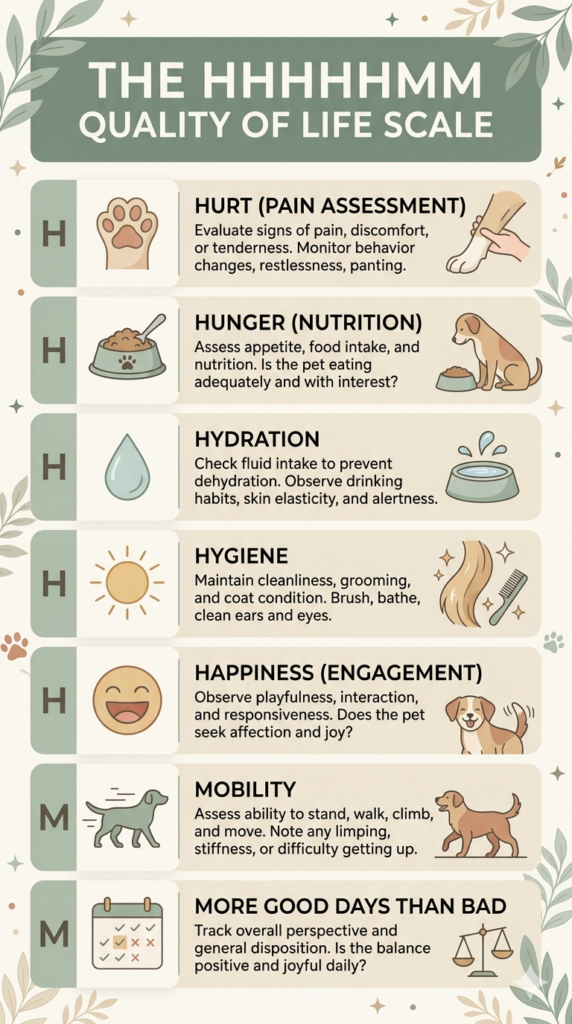
Quality of life is the framework veterinarians around the world use to evaluate end-of-life decisions. It is not about counting bad days, it is about understanding the balance between comfort and suffering, between dignity and decline. Dr. Alice Villalobos, a pioneer in veterinary oncology, developed the widely used HHHHHMM Quality of Life Scale, which assesses seven areas: Hurt, Hunger, Hydration, Hygiene, Happiness, Mobility, and More good days than bad. According to the American Veterinary Medical Association, this kind of structured reflection helps families move from emotion-only decisions to clarity-grounded ones.
A practical starting point is keeping a simple daily journal. Every evening, write one word that describes your pet’s day. Over two weeks, patterns appear that the heart alone cannot see.
Recognizing the Signs Your Pet May Be Telling You
Animals are remarkably stoic. They hide pain because, in the wild, vulnerability invites danger. As a result, the signs of suffering in dogs and cats can be subtle. Knowing what to look for is the first act of advocacy.
Physical indicators to watch closely:
- Persistent refusal of food or water across multiple days
- Difficulty standing, walking, or maintaining balance
- Laboured breathing, especially at rest
- Inability to control bladder or bowels combined with visible distress
- Open sores, untreatable tumors, or wounds that will not heal
- Sudden, dramatic weight loss in a short window
Behavioral changes that often whisper before they shout:
- Withdrawing from family members or hiding for long periods
- Sleeping in unusual locations, often cold floors or dark corners
- Loss of interest in toys, treats, or rituals that once brought joy
- Increased irritability or, less commonly, sudden clinginess
- Vocalizing through whining, panting, or unusual restlessness at night
A single sign in isolation rarely means it is time. A cluster of signs that persists, especially when paired with a clearly diminishing quality of life, is the harder truth most families eventually face. If you are watching these changes unfold and are not sure what they mean, an in-person evaluation with a trusted veterinarian is the most loving next step.
A Quiet Patient Story: Murphy’s Last Good Week
Some of the most meaningful goodbyes are the ones planned with care. A family we cared for last year brought in Murphy, a fourteen-year-old golden retriever with advanced kidney disease. They were not ready, no one ever truly is, but Murphy had stopped eating his favorite peanut butter biscuits and had begun looking for quiet corners alone.
Together, we mapped out a “last good week” plan. Murphy’s family took him to the lake one final time, fed him scrambled eggs every morning, invited his closest neighborhood friends (two dogs and a child he adored) to visit, and let him sleep in their bed. When the appointment came, he was surrounded by every face he loved, on his own blanket, with the smell of his family on every fiber. There were tears, of course, but also something quieter. Peace.
Many families describe the experience afterwards as devastating but right. Planning the goodbye, when circumstances allow, gives both pet and family a chance to be present rather than panicked.
The Conversation With Your Veterinarian
When you reach out about end-of-life care, your veterinarian is not there to push a decision in either direction. Our role is to translate medical reality into language your heart can hold. A good conversation usually covers four areas.
What we will assess together:
| Area | What we discuss |
|---|---|
| Medical reality | Diagnosis, prognosis, expected progression |
| Pain management | What is working, what no longer is, options remaining |
| Functional status | Mobility, appetite, hydration, continence |
| Family context | Your bandwidth, your pet’s social world, the home environment |
Helpful questions to ask your vet:
- What does the next two weeks likely look like for my pet?
- Are we still managing pain, or are we simply postponing it?
- What signs would tell you that suffering has begun to outweigh comfort?
- What are my realistic options if I want to wait, and what are the risks of waiting?
There is no wrong question. Some families need permission to let go. Others need permission to wait a little longer. Both are valid, and the right veterinary team will hold both without judgment. If you are searching for pet euthanasia near me options across the GTA, what matters most is the team’s willingness to slow down with you.
What Compassionate Pet Euthanasia Actually Looks Like
For families who have never been through this, the unknown can be the most frightening part. Demystifying the process tends to bring relief, not more grief.
Before the appointment. You will be asked to bring in any comfort items: a favorite blanket, a chew toy, even a t-shirt that smells like home. Most clinics will schedule the visit at a quieter time of day and allow extra time for goodbyes. You may be asked who will be present, and whether you would like to be with your pet through the procedure.
During the procedure. The process is intentionally gentle. A sedative is given first, often as an injection under the skin, which makes your pet sleepy and deeply relaxed within five to ten minutes. Many pets simply drift into a peaceful sleep on your lap. Once your pet is fully sedated, the veterinarian administers the final medication, typically through an intravenous catheter. Passing is usually quiet and quick, often within one to two minutes. There is no struggle, no fear, no awareness of what is happening. According to the Canadian Veterinary Medical Association, the medications used are specifically formulated to be painless and to prevent any distress.
After the procedure. You will be given as much time as you need. Some families stay for ten minutes, others for an hour. There is no rush. Your veterinary team will then walk you through aftercare options, including communal cremation, private cremation with returned ashes, or home burial where local regulations permit. Memorial keepsakes such as paw print impressions or fur clippings are usually offered.
In-Clinic or At-Home: Which Is Right for Your Family?
Both options offer dignity, and the right choice depends on your pet’s temperament and your family’s preferences.
| Setting | Best for | Considerations |
|---|---|---|
| In-clinic | Pets familiar with the clinic, families needing logistical simplicity, situations requiring rapid intervention | Quiet rooms with soft lighting, full medical support on hand |
| At-home (mobile) | Pets with severe anxiety in clinical settings, families wanting privacy in their own space | Limited availability, scheduling can be slower, often higher cost |
For many Brampton and Toronto families, an in-clinic farewell in a calm, dedicated comfort room offers the right blend of medical readiness and peaceful intimacy. The International Association for Animal Hospice and Palliative Care provides excellent additional resources for families weighing this choice.
Caring for Yourself Through Grief
Pet loss is real loss. A 2023 study published in the journal Anthrozoös found that the grief intensity following the death of a pet can rival that of losing a human family member, particularly when the bond was central to daily life. This is not weakness, it is love unspooling, and it deserves the same compassion you would offer any grieving friend.
Give yourself permission to feel everything. Some practical companions through grief:
- Keep one ritual you shared with your pet (a morning walk, an evening cup of tea by the window) for at least a few weeks
- Speak about your pet by name, sharing memories aloud helps
- Join a pet loss support group, the Ontario Veterinary College offers free phone support through the Pet Loss Support Hotline
- Be gentle with timelines, grief does not follow a calendar
Children and surviving pets in the household also grieve in their own ways. Honest, age-appropriate conversation with children, and continued routine for surviving animals, helps everyone re-find their footing.
For ongoing wellbeing of the pets still in your home, regular preventive care for pets helps catch issues early, before they become end-of-life decisions.
Frequently Asked Questions
-
How do I know if it’s the right time for pet euthanasia?
The right time is rarely obvious, which is why we encourage families to track quality of life daily over two weeks. When the bad days clearly outweigh the good, when pain can no longer be managed, when your pet has lost interest in food, family, and the things they once loved, these clustered signs typically indicate it is time. A veterinary consultation can help clarify what your heart already suspects.
-
Is pet euthanasia painful for my dog or cat?
No. The process is specifically designed to be free of pain or distress. A sedative is administered first, helping your pet drift into deep, relaxed sleep within minutes. Only once they are fully unconscious is the final medication given. Most pets appear to simply fall into a peaceful slumber. Veterinary protocols across Canada follow strict guidelines to ensure the entire process remains gentle and humane.
-
Should my children or other pets be present during the procedure?
This is a deeply personal decision. Many families find that including children, when age-appropriate, helps them process the loss honestly. Surviving pets sometimes benefit from being present afterward to understand their companion has gone. There is no single right answer. What matters is preparing everyone for what they will see, and giving family members the choice to step away if they need to.
-
What aftercare options are available after pet euthanasia near me?
Most clinics offer three main aftercare pathways: communal cremation (ashes are not returned), private cremation (your pet’s ashes returned to you, often in a wooden urn), and home burial where local Brampton and Toronto-area municipal bylaws allow. Memorial keepsakes such as clay paw prints, fur clippings, or nose impressions are commonly available. Discuss preferences with your veterinary team before the appointment.
-
Can I get emergency end-of-life support if my pet is suddenly suffering?
Yes. If your pet enters a sudden medical crisis, contact an emergency vet near me immediately. Sometimes the kindest decision must be made quickly, and a compassionate veterinary team will guide you through it with the same gentleness as a planned farewell. Always call ahead so the clinic can prepare a quiet room and your pet can be seen without delay.
Saying goodbye is the final act of love we give the ones who waited at the door, slept at our feet, and trusted us with their whole, short lives. May your goodbye be soft, and may your memories outlast the ache.