
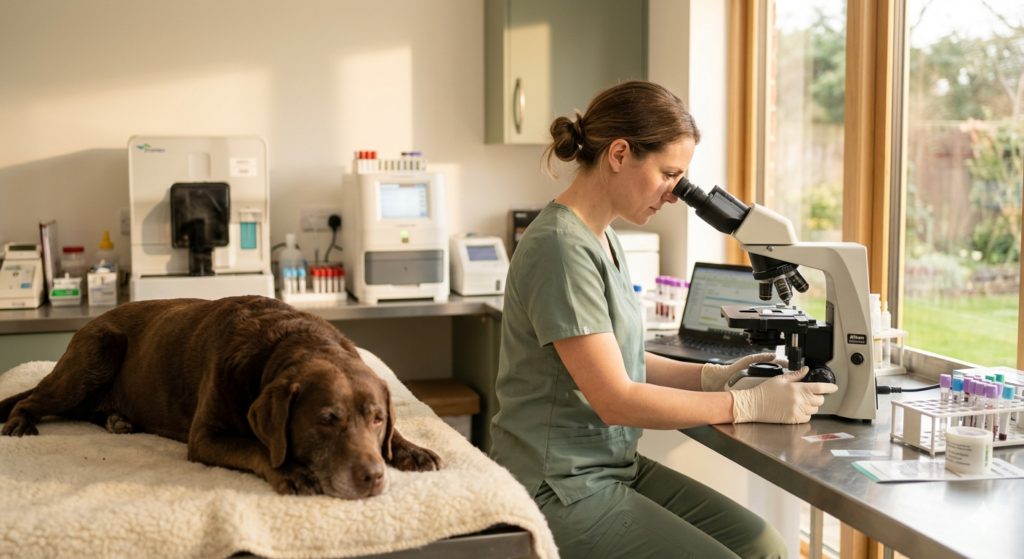
Imagine bringing your dog in at 8 PM on a Friday because he has been vomiting blood for two hours. The waiting alone is unbearable. Now imagine being told the test results will be back in three to five business days. That delay can be the difference between recovery and loss. This is why fast veterinary diagnostics matter so much, and why we built our in-house lab the way we did. At Lacoste Animal Hospital Brampton, our diagnostic suite is designed to deliver answers in minutes, not days, because in veterinary medicine, time is one of the few things we cannot replace.
This guide takes you behind the curtain. You will learn what actually happens after a blood sample leaves your pet’s vein, why some tests run on-site while others travel to specialized reference laboratories, and how the marriage of speed and accuracy translates directly into better outcomes for the pets we treat across the Greater Toronto Area.
The Critical Window: Why Speed Matters in Veterinary Medicine
For many serious conditions, the diagnostic window is measured in hours, not days. According to clinical guidance from the American Veterinary Medical Association, early diagnosis in cases of pancreatitis, acute kidney injury, and addisonian crisis significantly improves survival rates, sometimes doubling the chance of full recovery when caught and treated quickly.
Speed matters for three concrete reasons:
- Disease progression does not pause. Conditions like sepsis, internal bleeding, and toxic ingestion advance hour by hour. Lost time means lost tissue, lost organ function, and sometimes lost life.
- Treatment decisions hinge on hard data. Empirical guesses can carry the first ten minutes of care. After that, your veterinarian needs blood chemistry, electrolyte readings, imaging, and microscopy to make targeted choices.
- Families can act sooner. When you walk out of an appointment with answers rather than a “we will call you next week,” you can begin treatment, modify diet, or face difficult decisions on the same day.
The slower the diagnostic loop, the more guesswork enters the treatment plan. And guesswork in veterinary medicine has real consequences.
What Happens Inside Our Brampton Diagnostic Lab
Most pet owners never see the equipment that interprets their pet’s bloodwork. That is a shame, because the process is genuinely remarkable. Our in-house laboratory runs the same gold-standard analytical systems used by veterinary universities and large referral hospitals.
The Equipment That Powers Same-Day Results
Inside our lab you will find:
- Hematology analyzer: Provides complete blood counts (CBCs) within roughly seven minutes. This identifies infection, anemia, clotting issues, and immune responses.
- Chemistry analyzer: Reads liver enzymes, kidney values, glucose, electrolytes, and pancreatic markers in ten to fifteen minutes from a single small blood sample.
- Urinalysis station: Detects urinary tract infections, kidney disease, diabetes, and crystals, often in under twenty minutes.
- Digital cytology microscope: Allows real-time evaluation of skin lumps, ear infections, and fluid samples without waiting for outside review.
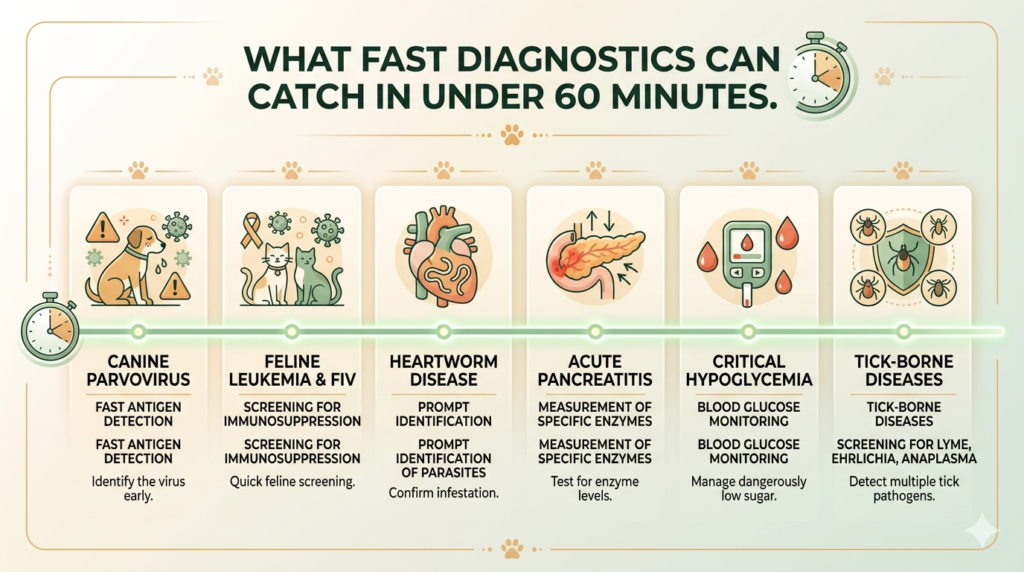
- In-house PCR and rapid antigen testing: Critical for parvovirus, FeLV/FIV, heartworm, and tick-borne diseases.
Alongside these, our state-of-the-art pet diagnostics suite includes digital radiography and high-resolution ultrasound, both performed and reviewed onsite.
Tests We Run Same-Day
When a pet arrives with concerning symptoms, the typical same-day diagnostic workup includes:
- Complete blood count and full chemistry panel
- Urinalysis with sediment evaluation
- Pancreatic-specific lipase (cPL) test
- Electrolyte and acid-base profile
- Digital X-rays of chest and abdomen
- Ultrasound for suspected abdominal issues
- Cytology of any masses, ear swabs, or skin scrapes
Most of these wrap up before you finish your second coffee in the waiting room.
A Patient Story: How Fast Diagnostics Saved Bella
A nine-year-old chocolate Lab named Bella was brought in one Saturday afternoon. Her owner had noticed she had been drinking water excessively for two weeks and seemed unusually tired. By the time of the visit, Bella was lethargic and refusing her breakfast.
A standard external lab arrangement would have meant waiting until Monday at the earliest for results. Instead, our team ran a full blood panel and urinalysis within forty minutes of her arrival. Her glucose level was dangerously high, her ketones were elevated, and her electrolytes were off-balance. Bella had diabetic ketoacidosis, a life-threatening condition that progresses quickly.
Because we had results in real time, we started IV fluids, regulated her insulin, and admitted her for monitoring that same afternoon. Three days later, she went home stable, tail thumping against the kennel door. Had her results taken even 24 hours longer, the outcome could have been very different. This is the difference fast veterinary diagnostics make, not in theory, but in living rooms across Brampton.
In-House Lab vs Reference Lab: When We Use Each
Not every test makes sense to run in-house, and not every test needs to be sent away. The art is knowing which is which.
| Test Type | Best Location | Why |
|---|---|---|
| CBC and chemistry panels | In-house | Speed is critical for sick patients |
| Urinalysis | In-house | Real-time evaluation, fresh sample matters |
| Cytology (basic) | In-house | Immediate clinical correlation |
| Histopathology | Reference lab | Requires board-certified pathologist review |
| Endocrine panels (T4, cortisol stim) | Reference lab | Specialized equipment, controlled environment |
| Culture and sensitivity | Reference lab | Bacteria take days to grow regardless of facility |
| PCR for unusual pathogens | Reference lab | Specialized molecular diagnostics |
For more complex workups, our partnership through reference laboratory testing with leading external labs ensures samples reach board-certified specialists within 24 hours, with most results returning the next business day. This combined approach gives us both speed and depth, without compromise.
Six Conditions Where Diagnostic Speed Genuinely Matters
Some emergencies hide inside symptoms that look mild. Fast veterinary diagnostics catch them before they become irreversible.
- Diabetic ketoacidosis. Survival often depends on whether glucose, ketones, and electrolytes are corrected within hours.
- Acute kidney injury. Toxin exposure such as lily ingestion in cats or grape and raisin ingestion in dogs can permanently damage kidneys within 48 hours.
- Addisonian crisis. Cortisol-related collapse mimics gastroenteritis. Without quick electrolyte panels, it is easily missed.
- Pancreatitis. Severe cases can spiral into systemic shock. The cPL test gives clarity within fifteen minutes onsite.
- Internal bleeding. Quick PCV/TS measurements and abdominal ultrasound differentiate a stable pet from a surgical emergency.
- Parvovirus in puppies. Mortality without aggressive supportive care exceeds 90 percent. Same-day diagnosis is non-negotiable.
These are not textbook examples. We see at least one of these every month at our clinic, and the families on the other side of those exam tables remember the speed of the answer for years.
How Our Diagnostic Process Works, Step by Step
For pet owners who like to know what to expect, here is the typical journey of a sick pet through our diagnostic process:
- Triage and history. A veterinary technician records symptoms, vital signs, and key history within the first five minutes.
- Physical exam. The veterinarian performs a thorough hands-on examination to narrow the differential diagnoses.
- Sample collection. Blood, urine, and any necessary swabs or aspirates are gathered quickly and gently.
- In-house analysis. Samples are processed onsite. Most chemistry and CBC results are ready in fifteen minutes or less.
- Imaging if indicated. Digital X-rays or ultrasound studies are completed during the same visit.
- Result review and treatment plan. The veterinarian discusses findings in plain language and recommends next steps.
- Treatment begins. Where appropriate, IV fluids, injectable medications, hospitalization, or surgery can start the same day.
This is what working with a true animal diagnostic clinic with onsite testing actually looks like. No fragmented care, no playing telephone with outside labs while your pet sits in distress.
Accreditation, Quality Control, and Why It Matters
Speed without accuracy is dangerous. Every analyzer in our lab undergoes daily quality control checks before the first sample of the day is ever run. Calibration logs, control samples, and routine maintenance are documented and reviewed. We follow protocols aligned with the Canadian Veterinary Medical Association and reference standards consistent with American Animal Hospital Association accredited practices.
This invisible discipline is what separates a confident diagnosis from a flawed one. When a chemistry panel comes back from our lab, your veterinarian is reading numbers that can be trusted, every single time.
The Human Side: Compassion Behind the Science
Technology alone does not save lives. The science only helps when it is delivered with patience and care. Our team explains results in language you can carry home, sketches diagrams when needed, and never rushes a worried owner out the door.
When you visit, the same veterinary technician who drew your pet’s blood may hand you a coffee while waiting for the panel. The same veterinarian who reads the chemistry results will sit with you afterwards to walk through what every number means. That continuity matters. It is what builds the trust that makes hard conversations bearable.
Frequently Asked Questions
-
How fast can you get results from in-house veterinary diagnostics?
Most in-house diagnostic results, including complete blood counts, chemistry panels, and urinalysis, are ready within 15 to 30 minutes of sample collection. Imaging studies such as digital X-rays are typically reviewed within minutes of being taken. More specialized tests sent to outside reference laboratories generally return within 24 to 72 hours, depending on the panel and the complexity of the analysis required.
-
Are veterinary diagnostic tests painful for my pet?
Most diagnostic tests cause minimal discomfort. Blood draws feel similar to a quick pinch and are over within seconds. Urinalysis usually involves a clean-catch sample or a brief ultrasound-guided collection. X-rays are completely painless and non-invasive. For pets that are anxious or fractious, we use gentle handling techniques and, when needed, mild sedation to ensure the experience stays calm and safe.
-
When does my pet need diagnostic testing?
Diagnostic testing is recommended whenever your pet shows new or persistent symptoms such as vomiting, lethargy, weight loss, changes in appetite or thirst, or behavioural shifts. Routine senior wellness panels (usually annually after age seven) catch silent diseases early. Pre-surgical bloodwork is standard. If your vet suggests testing, it is because clinical guesswork alone is not enough to safely guide treatment for what your pet is showing.
-
What is the difference between in-house and reference lab testing?
In-house testing is performed onsite at the animal hospital, producing results within minutes for urgent decisions. Reference lab testing is sent to specialized facilities equipped for complex analyses like histopathology, culture and sensitivity, and advanced endocrine panels. Both have a place. In-house testing prioritizes speed for emergencies. Reference labs prioritize depth for confirmation and rare cases. Our clinic uses both strategically based on what your pet needs.
-
Do I need an appointment for veterinary laboratory diagnostics?
For non-emergency diagnostic work, an appointment helps us prepare and reduces your wait time. For urgent situations such as vomiting, sudden lethargy, suspected toxicity, or injury, bring your pet in as soon as possible and call ahead so our team can prepare. Same-day diagnostic appointments are typically available, and emergency cases are triaged immediately upon arrival regardless of appointment status.
Behind every test result is a story, and behind every story is a family hoping for good news. Our lab exists to help those stories end well.