

It’s 9:40 on a Tuesday night. Your dog just threw up for the third time in an hour, and you’re standing in the kitchen with your phone in one hand, trying to decide if this is a “call in the morning” situation or a “get in the car right now” situation. That split-second judgment call is exactly why understanding pet urgent care versus emergency veterinary care matters so much for pet owners in Brampton and across the Peel Region. Getting it right can mean faster treatment, a calmer experience for your pet, and in some cases, the difference between a routine visit and a genuine crisis.
At Lacoste Animal Hospital, a trusted vet near me for families across Brampton, this is one of the most common questions our team hears. Owners aren’t being dramatic when they ask it. They’re trying to make a smart decision under pressure, usually with limited information and a pet who can’t tell them what’s wrong. This guide breaks down the real distinction between urgent and emergency care, what each visit actually looks like, and how to decide in the moment without guessing.
What Is Pet Urgent Care, Exactly?
Pet urgent care covers conditions that need same-day or next-available attention but aren’t immediately life-threatening. Think of it as the middle ground between “wait for your regularly scheduled appointment” and “this cannot wait one more minute.”
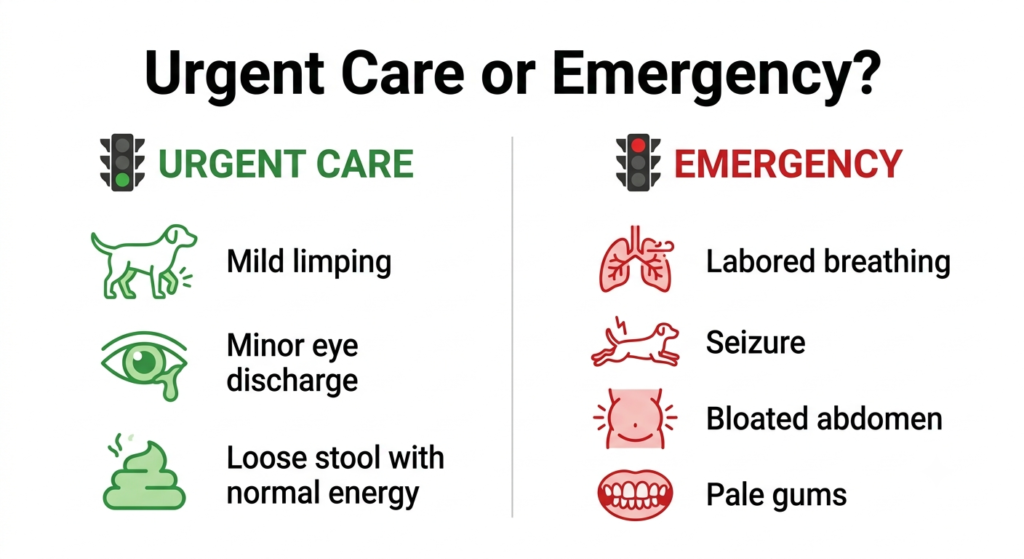
A limping dog who’s still eating and alert, a cat with a mild eye discharge, a puppy with loose stool but normal energy, or an ear infection that’s been building for a few days all typically fall into this category. These situations are uncomfortable and sometimes painful for your pet, but they generally aren’t putting organ function or survival at immediate risk.
Urgent care visits usually involve:
- A same-day or next-day appointment slot
- A standard physical exam and targeted diagnostics
- Treatment plans that can often be managed with medication and home care
- Follow-up scheduling if the condition needs monitoring
The goal of urgent care is to intervene before a manageable problem becomes a serious one, without the intensity, monitoring, or diagnostic urgency of a true emergency.
What Counts as a True Veterinary Emergency?
An emergency is different in kind, not just in degree. These are situations where minutes matter, where a delay of even an hour or two could change the outcome. Veterinary emergency medicine exists precisely because certain conditions progress fast enough that “wait and see” isn’t a safe option.
Signs That Cannot Wait
According to guidance published by the American Veterinary Medical Association, pet owners should seek immediate veterinary attention for signs such as difficulty breathing, repeated vomiting or bloody diarrhea, seizures, collapse, suspected poisoning, inability to urinate, traumatic injury, sudden paralysis, or uncontrolled bleeding. Additional red flags include: Lacosteanimalhospital
- A dramatically swollen or distended abdomen (a possible sign of bloat, which can be fatal within hours in large-breed dogs)
- Pale or blue-tinged gums
- A body temperature that feels unusually hot or cold to the touch
- Straining to urinate with little or no output, especially in male cats
- Sudden inability to stand or walk normally
- Ingestion of a known toxin, foreign object, or medication not prescribed for the pet
Pet Urgent Care vs Emergency Vet: A Side-by-Side Comparison
Because the line between these two categories isn’t always obvious in the moment, a direct comparison often helps.
| Factor | Pet Urgent Care | Emergency Vet |
|---|---|---|
| Timeframe | Same day or within 24-48 hours | Immediately, no delay |
| Typical conditions | Limping, mild vomiting, skin irritation, minor ear infections | Seizures, poisoning, difficulty breathing, severe trauma |
| Risk level | Uncomfortable, not immediately life-threatening | Potentially life-threatening |
| Appointment need | Often requires a call ahead | Walk-ins generally accepted |
| Diagnostics involved | Basic exam, sometimes bloodwork or imaging | Rapid diagnostics: X-rays, ultrasound, bloodwork, often all at once |
| Monitoring | Usually sent home with instructions | May require hospitalization or continuous observation |
| Owner action | Schedule a visit and monitor symptoms | Head to the clinic right away, call ahead if possible |
A Real-World Scenario: Two Dogs, Two Very Different Nights
Case studies help illustrate why this distinction matters more than it might seem on paper. The following is an anonymized composite drawn from patterns our team sees regularly, not a single client record.
Dog One: A three-year-old beagle mix stopped putting weight on her back leg after a backyard play session. She was still wagging her tail, eating dinner, and moving around the house, just favoring the leg. Her owner called the next morning and got her in for a same-day urgent care appointment. An exam and a set of X-rays ruled out a fracture, and she went home with anti-inflammatory medication and activity restrictions. Within a week, she was back to normal.
Dog Two: A seven-year-old Labrador retriever suddenly seemed restless, tried to vomit without bringing anything up, and his abdomen looked visibly swollen within the span of about 30 minutes. His owners recognized the signs of a potential gastric emergency and brought him in immediately rather than waiting for morning. Rapid imaging confirmed the concern, and same-day surgical intervention addressed the issue before it became critical.
Same general category (a dog acting differently than usual), completely different levels of urgency. The deciding factors were the speed of onset, the presence of specific red-flag symptoms, and how the animal’s overall condition was trending.
What Happens During a Pet Urgent Care Visit
Understanding the actual flow of an urgent care appointment can ease a lot of the anxiety around booking one. Generally, it looks like this:
- Phone triage – A team member asks a few quick questions to understand symptoms and confirm the visit is appropriate for urgent (not emergency) care.
- Same-day or next-available scheduling – You’re given a specific time rather than an open-ended wait.
- Focused physical exam – The veterinarian examines the specific area of concern along with a general health check.
- Targeted diagnostics if needed – Bloodwork, a skin scrape, or imaging may be recommended based on findings.
- Treatment and take-home plan – Medication, dietary adjustments, or a follow-up recommendation.
What Happens During an Emergency Vet Visit
Emergency care follows a faster, more intensive sequence built around stabilization first, answers second.
- Immediate triage on arrival – Vital signs are checked the moment you walk in, often before formal registration.
- Stabilization – Oxygen, IV fluids, or pain control may begin before a full diagnosis is confirmed.
- Rapid diagnostics – Digital X-rays, ultrasound, and lab testing are used to identify the cause quickly. Lacosteanimalhospital
- Treatment or surgery – Depending on findings, treatment may proceed the same visit, including surgical intervention for conditions like bloat, internal trauma, or toxin ingestion.
- Monitoring and discharge planning – Pets are observed until stable, with detailed home-care instructions provided afterward.
How to Decide in the Moment
When you’re standing in your kitchen at 9:40 p.m. trying to make a call, a simple mental checklist helps more than panic ever will. Ask yourself:
- Is my pet still responsive and aware of their surroundings? A dazed or unresponsive pet needs immediate care.
- Are they breathing normally? Labored, rapid, or shallow breathing is never a “wait it out” sign.
- Is there any visible swelling, bleeding, or distension? These point toward urgent or emergency evaluation depending on severity.
- Has this happened once or repeatedly in a short window? A single mild vomiting episode differs significantly from six episodes in two hours.
- Is the pet still eating, drinking, and moving somewhat normally? Preserved basic function often (not always) points toward urgent rather than emergency care.
If you answer any of the breathing, collapse, seizure, or bleeding questions with concern, don’t spend time deliberating further. Head in immediately.
Why Fast Access to Care Changes Outcomes
Recent industry data underscores just how often pet owners face this exact decision. National survey research has found that a meaningful share of pet parents report visiting the vet for sudden, unexplained symptoms each year, and toxin ingestion remains a common driver of emergency visits among surveyed pet parents. Separate research on veterinary service use found that a notably higher percentage of dog owners have visited an emergency veterinary clinic compared to cat owners, which tracks with how differently the two species tend to mask or display distress. PubMed CentralDogster
What this data reinforces is simple: sudden veterinary needs are common, not rare exceptions. Having a clear framework for urgent versus emergency care, and a clinic nearby that offers both, removes a layer of stress from an already stressful moment.
This is also where diagnostics matter enormously. Whether a visit turns out to be urgent or emergent, fast, accurate in-house diagnostics shape how quickly a veterinary team can move from “something is wrong” to “here’s exactly what’s wrong and how we treat it.” On-site imaging and lab work remove the delay of sending samples out and waiting days for results, which matters just as much for a same-day urgent visit as it does for a true emergency.
Proximity plays a role too. If you’d like a closer look at why nearby, accessible veterinary care tends to produce better outcomes across both urgent and emergency situations, our team has written more on recognizing early warning signs before they escalate.
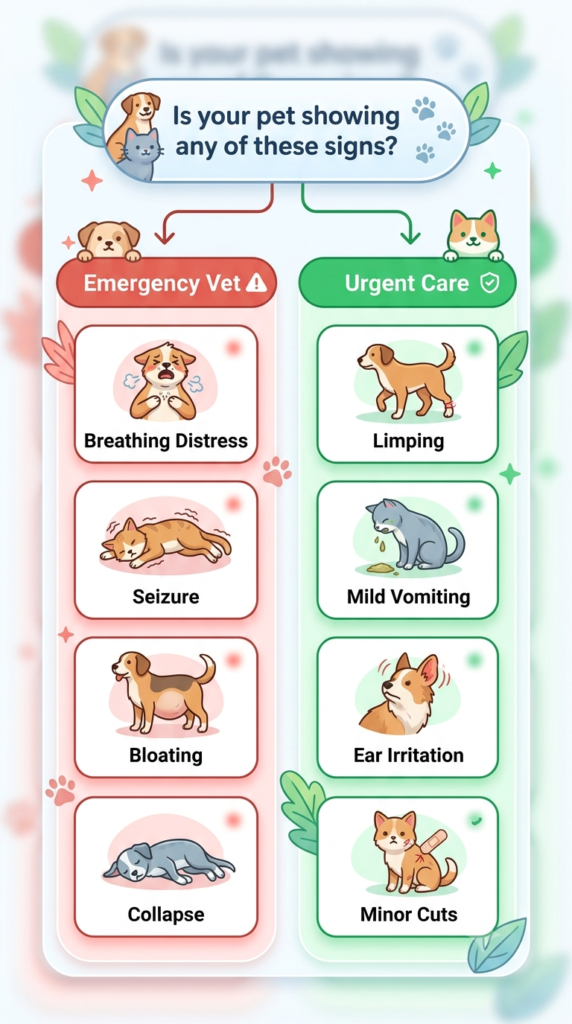
Comparison: Common Symptoms and Their Likely Category
| Symptom | Likely Category | Why |
|---|---|---|
| Mild limping, still walking | Urgent care | No systemic distress, manageable timeline |
| Vomiting once, otherwise normal | Urgent care | Monitor first, treat if it continues |
| Vomiting repeatedly within hours | Emergency | Risk of dehydration and underlying obstruction |
| Small surface cut, not bleeding heavily | Urgent care | Cleanable and treatable same-day |
| Deep wound with heavy bleeding | Emergency | Risk of blood loss and infection |
| Mild ear scratching | Urgent care | Common, treatable infection |
| Sudden collapse or seizure | Emergency | Immediate risk to brain and organ function |
| Swollen, distended abdomen | Emergency | Possible bloat, rapidly fatal without treatment |
Aftercare: What Happens Once You’re Home
Whether your visit was urgent or emergency-level, aftercare follows a similar pattern. Veterinary teams typically provide written instructions covering medication schedules, activity restrictions, warning signs that warrant a follow-up call, and a timeline for reassessment. Following these instructions closely, even after your pet seems back to normal, reduces the chance of a relapse or a second visit for the same underlying issue.
The Bottom Line for Pet Owners
You don’t need veterinary training to make a reasonably good call about urgent versus emergency care. You need a clear framework, a bit of observation, and a clinic you trust to guide you the rest of the way if you’re still unsure. When in doubt, a quick phone call to your veterinary team before you make the drive is almost always the right first move; a trained team can help you triage over the phone in a way that Google searches at midnight simply cannot.
Frequently Asked Questions
-
What is the main difference between pet urgent care and an emergency vet?
Pet urgent care addresses conditions that need same-day or next-available attention but aren’t immediately life-threatening, like mild limping or a minor skin irritation. An emergency vet visit is for conditions where delay itself poses a risk, such as difficulty breathing, seizures, or severe trauma. The distinguishing factor is timeline: hours matter for urgent care, minutes matter for emergencies.
-
Can I walk into an urgent care vet visit without an appointment?
Some clinics accommodate same-day walk-ins for urgent concerns, though calling ahead is generally recommended so the team can prepare and give you an accurate wait estimate. Emergency situations are typically handled differently, with walk-ins accepted immediately regardless of scheduling, since stabilization cannot wait for a booked slot. If you’re uncertain which category applies, a quick phone call helps clarify the right path forward.
-
How do I know if my pet’s vomiting is urgent or an emergency?
A single vomiting episode in an otherwise alert, active pet is usually manageable through urgent care. Repeated vomiting within a short window, vomiting paired with lethargy or a swollen abdomen, or vomiting blood are signs that point toward an emergency. The pattern and accompanying symptoms matter more than the vomiting alone, so watch closely during the first hour or two.
-
Is a limping dog considered an emergency?
Not usually. Most limping cases, especially when the dog is still bearing some weight, eating normally, and alert, fall under urgent care rather than emergency treatment. However, a limp accompanied by visible bone deformity, extreme pain vocalization, or an inability to bear any weight at all should be treated as a more urgent, same-day concern rather than something to monitor at home.
-
What should I bring to an urgent care or emergency vet visit?
Bring any medication your pet currently takes, packaging from a suspected toxin if ingestion is a concern, and a brief timeline of when symptoms started. If your pet has pet insurance, having your policy information on hand streamlines the visit. For emergencies specifically, focus on getting to the clinic quickly rather than gathering everything perfectly first.
Trust your instincts, watch for the signs that matter, and never hesitate to make the call, because a quick phone consultation almost always beats a guessing game at midnight.